Showing posts with label solarsharing. Show all posts

Monday, May 8, 2023

Japanese Government Considering Tighter Regulations for Agrivoltaics

This year marks 10 years since the introduction of the agrivoltaics in Japan. An estimated more than 5,000 power plants have been introduced, but at the same time, the number of cases of improper farming under PV is increasing.

Power generation facilities without adequate agriculture


According to MAFF statistics, there are 335 operating agrivoltaics in Japan with insufficient agricultural production. In more than half of them, the yield is between 0 and 20% or less.

To solve this problem, MAFF and the ruling Liberal Democratic Party (LDP) each established a study group.

MAFF's study group heard reports from local government officials, which revealed cases of low agricultural productivity and the actions of businesses attempting to conduct power generation projects even in situations that violate the Agricultural Land Law.

Why are these problems occurring? Local government officials point out that the problem lies in the fact that the operation of FarmingPV is not prescribed by law, but rather by administrative notice.

Japan's Special Zones for Structural Reform Act, enacted in April 2023, eased restrictions on the acquisition of farmland by corporations, but prohibited the introduction of agrivoltaics when using this system.

In light of this situation, some agricultural groups have argued that the locations where agrivoltaics can be installed should be more severely restricted, and future regulatory discussions will need to be closely monitored.

Monday, June 28, 2021

Design Patterns for Agrivoltaics in Japan

The design of Agrivoltaics or solar-sharing systems in Japan has changed significantly since the start of their widespread use in 2013.

The concept of the project was divided into two main categories: prioritizing agriculture and prioritizing the power generation business. The decision has been made to prioritize reasonable profits from power generation projects in the face of severe cost tightening by Japan's FIT, or to pursue designs that are more suitable for farming and crops.

The one that has been prioritizing the profitability of the power generation business is a design known as the Array type. This is simply a taller pillar of the racks used in ordinary ground-mounted solar power plants.

Array type solar-sharing

In the case of the array system, it can be installed at a cost not much different from that of a ground-mounted solar power plant, but the shading rate may be uneven and agricultural machinery may be difficult to use.

In contrast, the Fujidana style design, in which solar panels are installed evenly, has been actively adopted. This design has been adopted with the idea of prioritizing farm work and agricultural production.

Early Fujidana style solar-sharing

In the early stages of the widespread use of solar sharing, the use of slim solar panels was favored in addition to this uniform solar panel design. However, this custom-made solar panel has become less common in recent years due to the increasing difficulty in obtaining them.

For the past three years or so, there has been an increase in the use of Fujidana style mounts with large solar panels as a design that allows for both farming and power generation projects.

The latest model of Fujidana style solar-sharing


Thursday, June 24, 2021

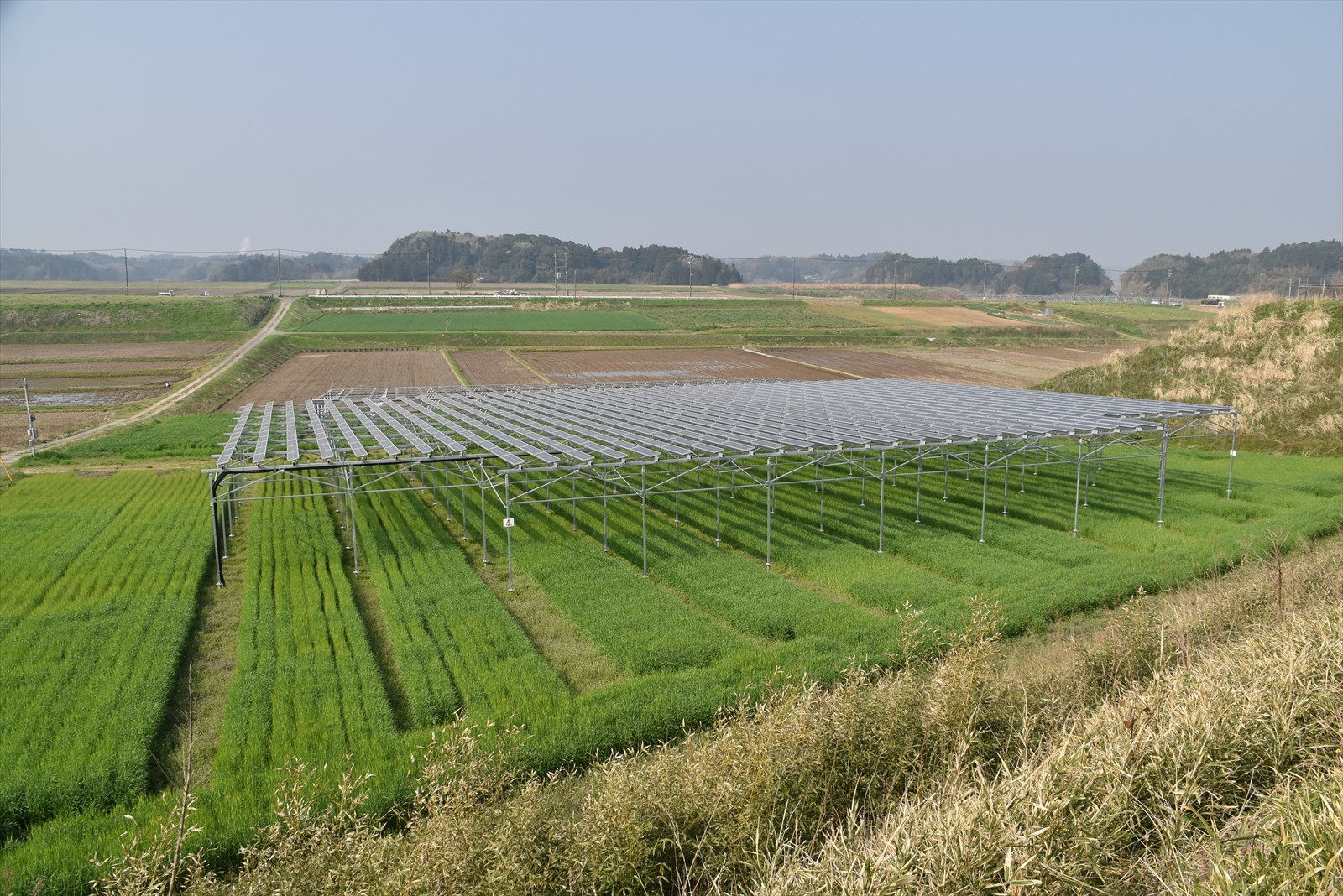
Rice Farming and Agrivoltaics

Rice is the staple food of the Japanese people, and rice farming is also being used in agrivoltaics.

A shading ratio of around 35% is suitable for growing rice, and famous varieties such as Koshihikari and Akitakomachi are grown here.

Planting of Akitakomachi rice

Impacts on the growing environment include slightly cooler water temperatures and delayed ripening, which generally delays the harvest time by about one week.

However, a slight delay in growth is not a problem for farmers, as the income from the sale of electricity from solar power generation is about 10 times higher than the production value of rice.

Since it is not practical to install agrivoltaic systems in all the paddy fields without any gaps, only some of them are installed to support the farmers' income.

With the increasing automation of agricultural machinery used in paddy fields, the decline in workability and other problems are expected to eventually improve.

Wednesday, June 23, 2021

Agrivoltaics installation trends by region in Japan

In Japan, the number of agrivoltaics installations has gradually increased since 2013, but there are regional differences. 

Chiba Prefecture is the birthplace of solar sharing, and the number of installations has been increasing there and elsewhere.

From there, it began to spread to the Kanto region, where there are players who are enthusiastic about the solar sharing business, and installation is now underway in Shizuoka and Gunma prefectures.


There are more installations in eastern Japan than in western Japan, and more installations on the Pacific side than on the Sea of Japan side because of better sunlight conditions.

In recent years, grid connection constraints for renewable energy power plants have become a major social issue, and projects are concentrated in the Kanto region, where there is relatively more room for growth.

70% of new solar sharing applications in 2018 were in the Kanto region. 

Since Japan has a strong tendency to be precedent-based, I assume that the spread of this type of system will be further promoted in areas where the number of installations is increasing.

Tuesday, June 22, 2021

About crops grown under agrivoltaics in Japan.

A wide variety of crops, including grains and vegetables, are grown in agrivoltaics in Japan. It can be installed on a variety of farmland, but there is a regulation that the yield must not be reduced by more than 20% from the regional average.

Soybean

Eggplant

Taro

In Japan, half of the country's agricultural land is paddy fields, which produce rice, the country's staple food. Rice can be grown without any problem if the shading ratio of agrivoltaics is about 35%.

Paddy field

Data on the shading rate of agrivoltaics and crop growth has been accumulated, and the future challenge is to improve productivity by taking advantage of the shading environment.

Monday, June 21, 2021

Agrivoltaics system in Japan

Agrivoltaic is called "solar sharing" in Japan. In 2013, the Ministry of Agriculture, Forestry and Fisheries (MAFF) set up a system that began to spread, but a small number of power plants had been installed before then.

Power plants installed in the early years

The term "solar sharing" is used by the private sector, while the Ministry of Agriculture, Forestry and Fisheries uses the term "farm-based solar power generation". In English, the official term is "Farming Photovoltaics".

Reference: MAFF special website on Farming Photovoltaics.
https://www.maff.go.jp/j/shokusan/renewable/energy/einou.html#guidebook

96 power plants were installed in 2013, and the number has been hovering around 300 to 400 annually since then. Most of them are using the Feed-in Tariff.

In Japan, solar sharing is given special treatment under the Agricultural Land Law, and can be installed even on agricultural land, where use for anything other than agriculture is strictly restricted.

Since the system was launched with the aim of improving the income of farmers, it is characterized by a high degree of flexibility in terms of installation locations.

Sunday, June 20, 2021

About Agrivoltaics Japan

This blog will provide information on Agrivoltaics in Japan, which is not very well known.

In Japan, an initiative called solar sharing or Farming PV is spreading.

Let's take a look together at the new future painted by the collaboration between renewable energy and agriculture.


Case studies of Agrivoltaics in rice paddies in Japan

Japanese agriculture, as seen in the Agrivoltaics, is very distinctive compared to other countries. Of these, the Japanese approach to Agric...