Showing posts with label agriculture. Show all posts

Friday, September 6, 2024

Case studies of Agrivoltaics in rice paddies in Japan

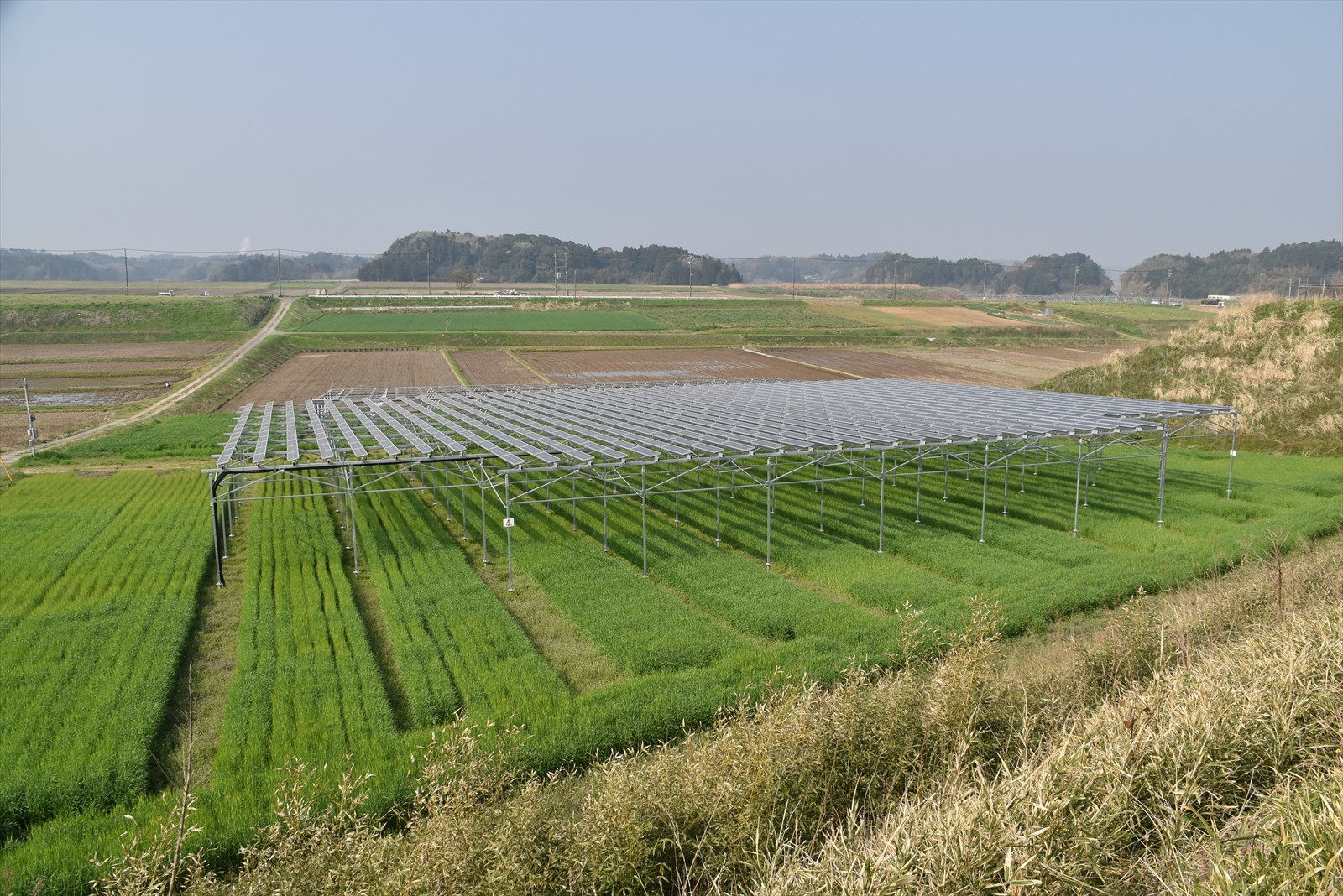
Japanese agriculture, as seen in the Agrivoltaics, is very distinctive compared to other countries. Of these, the Japanese approach to Agricoltaics in rice paddies is probably the most advanced.

From August to September is the peak harvest season for rice grown in paddy fields. This is no exception for the Agricoltaics. The photo shows the rice harvest at an Agricoltaics in a paddy field in Chiba City, near Tokyo.

Rice harvesting at an Agrivoltaics near Tokyo

Rice paddies account for 55% of agricultural land in Japan, and if we can utilise them as an agri-PV, we can develop both agriculture and renewable energy businesses. For this reason, in Japan, demonstration tests of Agrivoltaics in rice paddies have been carried out for over 10 years.

As a result, general-purpose agricultural machinery can operate without any problems in the PV facilities. The decrease in rice yield has been kept within 10%.

Work using a general-purpose combine harvester

In Japanese rice farming, the work carried out by agricultural machinery, from rice transplanters to combine harvesters, is systematised, so if some successful examples of Agrivoltaics are created, the same approach will probably spread.

At present, we are conducting research into the production of renewable energy and decarbonisation in agricultural areas through joint research with Chiba University. The results of this research will be published in papers and other publications in stages.

https://www.de-carbon-farmland.org/

Friday, January 21, 2022

Japan's Youth Enter Agriculture with Agrivoltaics

The decrease in the number of agricultural workers is an important social issue for Japan. In such an environment, the entry of young people into agriculture through agrivoltaics is spreading.

University students experiencing farm work with agrivoltaics.

In Japan, the agricultural population has declined by 70% over the past 20 years, while the number of young people entering the agricultural business has remained at a very low level.

On the other hand, more and more young people are interested in building a sustainable society due to the growing interest in climate change issues. Such young people have started to address energy and agricultural issues through agrivoltaics.


In the future, it is necessary to use renewable energy sources to reduce the environmental impact of agricultural production. By learning about agrivoltaics, which combines renewable energy and agriculture on farmland, the next generation will gain a new sense of value.

Saturday, August 21, 2021

Standard Design for Agrivoltaics in Japan

Fujidana style and array designs are the most common types of solar sharing in Japan. In the case of the Fujidata style, which can equalize the amount of solar radiation to crops, a shading ratio of about 40% can be considered as a standard design.

Fujidata style in Japan

The number of solar panels that can be installed with a shading ratio of 40% is about 1,800 per hectare of farmland.

As of 2021, solar panels with an output of around 450W are the mainstream, so 810kWp is the output of solar power generation.

Depending on the region where it is installed, it can be expected to generate 900,000 to 1,000,000 kWh of electricity per year.

Since the current unit price for electricity sales under Japan's FIT is 11 yen/kWh, we estimate that the annual income from electricity sales will be between 10 million yen and 11 million yen.

On the other hand, the annual sales of crops in a paddy field of the same size will be about 1 million yen, while in a field it will be 3 to 5 million yen.

Working with tractors

The distance between the pillars should be about 4 to 5 meters, and the overall height of the facility is designed to be about 4 meters. By doing so, we aim to secure the working space for agricultural machinery and solar radiation from scattered light.

Monday, August 2, 2021

Leafy Vegetables and Agrivoltaics

One of the characteristic agricultural products grown under agrivoltaics is leafy vegetables such as cabbage and lettuce. 

Since they are easily affected by strong sunlight, shading with solar panels will help the growth of leafy vegetables.

Growing Cabbage and Lettuce

In the lowlands of Japan, summers are too hot for growing leafy vegetables. However, solar sharing makes it possible to grow leafy vegetables by blocking the strong summer sunlight.

Another known benefit of the presence of solar panels is that they help to control frost in winter. Therefore, in areas where leafy vegetables could not be grown in the winter, it has become possible to grow cabbage and other crops through solar sharing.

Of course, it's not just good for leafy greens. Shading by solar panels delays the drying of the ground after rain. This can lead to disease outbreaks due to moisture damage.

Nevertheless, the advantage of being able to grow vegetables that could not be grown within the region before will bring about a very significant change.

Saturday, July 3, 2021

Increase in agricultural participation triggered by Agrivoltaics

The spread of agrivoltaics has encouraged new entrants to agriculture in Japan.

As of 2020, the agricultural population in Japan has declined to one-tenth of what it was 60 years ago. The average age of farmers has reached 67, so we need to increase the number of young people entering the industry.

Strangely enough, more and more young people and businesses in Japan are taking advantage of agrivoltaics to enter the agricultural industry.

Young people in their twenties are moving toward agriculture

Currently, solar power companies in Japan are actively engaged in agrivoltaics. It is not uncommon for businesses that have been involved in the solar power business to enter the agriculture industry by getting involved in agrivoltaics.

It seems that this experience with renewable energy has sparked an interest in agriculture.

So why is the younger generation interested in this? It is probably because they have a stronger interest in energy and agricultural sustainability.

The income from energy makes it easier to engage in agriculture. And there is a growing trend to use renewable energy in agriculture, rather than simply selling electricity.

The time will soon come when solar sharing will be the common choice for newcomers to agriculture.

Sunday, June 27, 2021

Utilization of Renewable Energy in Agriculture

Agrivoltaics allows us to secure large amounts of electricity on farmland, and we are working on ways to use it for agriculture.

Although large agricultural machinery such as tractors have not yet been electrified in Japan, demonstration experiments are underway with small agricultural machinery and electric vehicles.

The installation of these machines that utilize the electricity from agrivoltaics will help decarbonize agriculture and rural communities.

Toyota Auto Body's ultra-compact electric vehicle

Radio-controlled electric agricultural machinery

In rural areas, life would not be possible without automobiles. In the past three years, Japan has experienced multiple large-scale power outages, which has drawn attention to the introduction of electric vehicles powered by local renewable energy.

The rural village where we are doing agrivoltaics also experienced 8 days of power outage in 2019 due to typhoon. At that time, we could no longer get enough gasoline for our cars.

Based on this experience, the use of electricity from agrivoltaics for mobility has made it possible to secure a means of transportation and power source in times of disaster.

In the future, we will introduce more electric agricultural machinery to improve agricultural productivity and decarbonization.

Thursday, June 24, 2021

Rice Farming and Agrivoltaics

Rice is the staple food of the Japanese people, and rice farming is also being used in agrivoltaics.

A shading ratio of around 35% is suitable for growing rice, and famous varieties such as Koshihikari and Akitakomachi are grown here.

Planting of Akitakomachi rice

Impacts on the growing environment include slightly cooler water temperatures and delayed ripening, which generally delays the harvest time by about one week.

However, a slight delay in growth is not a problem for farmers, as the income from the sale of electricity from solar power generation is about 10 times higher than the production value of rice.

Since it is not practical to install agrivoltaic systems in all the paddy fields without any gaps, only some of them are installed to support the farmers' income.

With the increasing automation of agricultural machinery used in paddy fields, the decline in workability and other problems are expected to eventually improve.

Wednesday, June 23, 2021

Agrivoltaics installation trends by region in Japan

In Japan, the number of agrivoltaics installations has gradually increased since 2013, but there are regional differences. 

Chiba Prefecture is the birthplace of solar sharing, and the number of installations has been increasing there and elsewhere.

From there, it began to spread to the Kanto region, where there are players who are enthusiastic about the solar sharing business, and installation is now underway in Shizuoka and Gunma prefectures.


There are more installations in eastern Japan than in western Japan, and more installations on the Pacific side than on the Sea of Japan side because of better sunlight conditions.

In recent years, grid connection constraints for renewable energy power plants have become a major social issue, and projects are concentrated in the Kanto region, where there is relatively more room for growth.

70% of new solar sharing applications in 2018 were in the Kanto region. 

Since Japan has a strong tendency to be precedent-based, I assume that the spread of this type of system will be further promoted in areas where the number of installations is increasing.

Tuesday, June 22, 2021

About crops grown under agrivoltaics in Japan.

A wide variety of crops, including grains and vegetables, are grown in agrivoltaics in Japan. It can be installed on a variety of farmland, but there is a regulation that the yield must not be reduced by more than 20% from the regional average.

Soybean

Eggplant

Taro

In Japan, half of the country's agricultural land is paddy fields, which produce rice, the country's staple food. Rice can be grown without any problem if the shading ratio of agrivoltaics is about 35%.

Paddy field

Data on the shading rate of agrivoltaics and crop growth has been accumulated, and the future challenge is to improve productivity by taking advantage of the shading environment.

Case studies of Agrivoltaics in rice paddies in Japan

Japanese agriculture, as seen in the Agrivoltaics, is very distinctive compared to other countries. Of these, the Japanese approach to Agric...