Friday, September 6, 2024

Case studies of Agrivoltaics in rice paddies in Japan

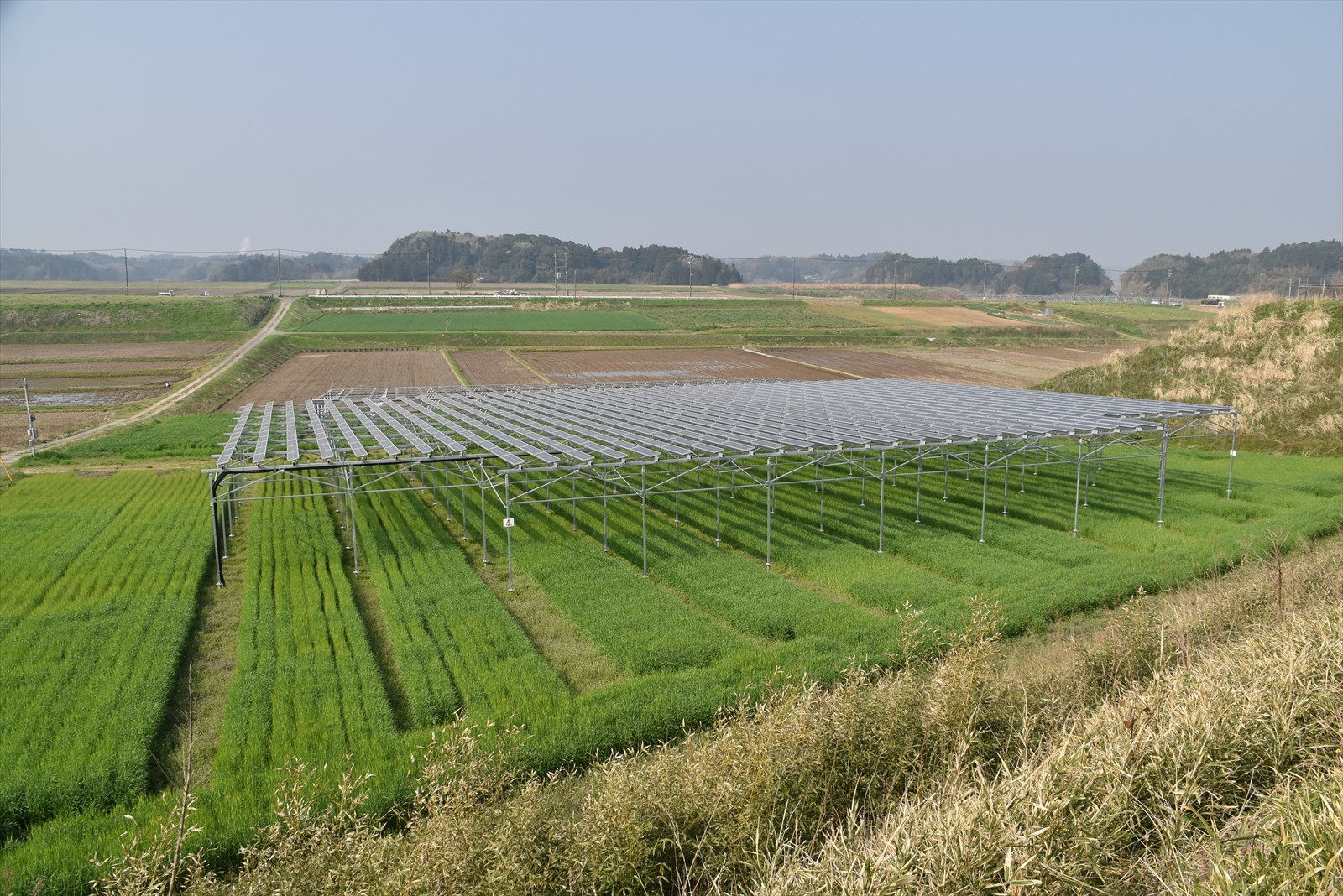
Japanese agriculture, as seen in the Agrivoltaics, is very distinctive compared to other countries. Of these, the Japanese approach to Agricoltaics in rice paddies is probably the most advanced.

From August to September is the peak harvest season for rice grown in paddy fields. This is no exception for the Agricoltaics. The photo shows the rice harvest at an Agricoltaics in a paddy field in Chiba City, near Tokyo.

Rice harvesting at an Agrivoltaics near Tokyo

Rice paddies account for 55% of agricultural land in Japan, and if we can utilise them as an agri-PV, we can develop both agriculture and renewable energy businesses. For this reason, in Japan, demonstration tests of Agrivoltaics in rice paddies have been carried out for over 10 years.

As a result, general-purpose agricultural machinery can operate without any problems in the PV facilities. The decrease in rice yield has been kept within 10%.

Work using a general-purpose combine harvester

In Japanese rice farming, the work carried out by agricultural machinery, from rice transplanters to combine harvesters, is systematised, so if some successful examples of Agrivoltaics are created, the same approach will probably spread.

At present, we are conducting research into the production of renewable energy and decarbonisation in agricultural areas through joint research with Chiba University. The results of this research will be published in papers and other publications in stages.

https://www.de-carbon-farmland.org/

Sunday, October 8, 2023

Combining Fruit Growing with Agrivoltaics

Fruit cultivation is a distinctive achievement when combining agrivoltaics and agricultural crops.

In Japan, blueberries, grapes, lemons, figs, tangerines, and other fruits are grown with agrivoltaics. Fruit trees can be planted in the ground or in pots, but the main feature is that the crops are grown using photovoltaic mounts. For example, bird nets are put up, watering pipes are crawled over, and grape trellises are built.

In recent years, the presence of shade from solar panels with agrivoltaics will become even more important, as the heat of summer has adversely affected the growth of fruit trees due to drastic climate change.

Agrivoltaics may become indispensable for orchards in the future.

Monday, May 8, 2023

Japanese Government Considering Tighter Regulations for Agrivoltaics

This year marks 10 years since the introduction of the agrivoltaics in Japan. An estimated more than 5,000 power plants have been introduced, but at the same time, the number of cases of improper farming under PV is increasing.

Power generation facilities without adequate agriculture


According to MAFF statistics, there are 335 operating agrivoltaics in Japan with insufficient agricultural production. In more than half of them, the yield is between 0 and 20% or less.

To solve this problem, MAFF and the ruling Liberal Democratic Party (LDP) each established a study group.

MAFF's study group heard reports from local government officials, which revealed cases of low agricultural productivity and the actions of businesses attempting to conduct power generation projects even in situations that violate the Agricultural Land Law.

Why are these problems occurring? Local government officials point out that the problem lies in the fact that the operation of FarmingPV is not prescribed by law, but rather by administrative notice.

Japan's Special Zones for Structural Reform Act, enacted in April 2023, eased restrictions on the acquisition of farmland by corporations, but prohibited the introduction of agrivoltaics when using this system.

In light of this situation, some agricultural groups have argued that the locations where agrivoltaics can be installed should be more severely restricted, and future regulatory discussions will need to be closely monitored.

Saturday, February 19, 2022

Japanese government's expert panel on agrivoltaics launched

In Japan, the design and construction guidelines for solar sharing/agrivoltaics were released last year. 

As the total number of agrivoltaics installations in Japan is estimated to have exceeded 4,000, the creation of a system to ensure the stability and sustainability of the facilities has begun.

As part of the new initiative, the Ministry of Agriculture, Forestry and Fisheries (MAFF) launched an expert panel in February 2022. The first item on the agenda here is to sort out the challenges of agrivoltaics in Japan. I also serve on the committee as an expert.

MAFF Japan Exeprt panel on agrivoltaics (Japanese)

There are three main issues to discuss: the first is the equipment and structure of the power plant, the second is the cultivation of crops, and the third is the business scheme.

In terms of the facilities and structure of the power plant, the main issues to be discussed are whether there is enough space for agricultural machinery to work safely, whether the plant can accommodate future smart agriculture, and whether the plant can withstand natural disasters such as typhoons and earthquakes.

In terms of crop cultivation, the agenda includes agricultural technology that takes into account the shading environment of solar panels, concerns about shifting to more easily cultivated crops, abandoning agricultural production in favor of power generation projects, and harmony with the rural landscape.

Regarding the business scheme, there are issues to be addressed such as unclear business responsibilities in cases where the owner of the power generation equipment and the farmer are different, a mechanism to encourage farmers to also engage in the power generation business, and the lack of financing and insurance products by financial institutions.

The expert panel is expected to sort out these issues by March 2022, and discussions to resolve more detailed issues will begin in the next fiscal year.

Friday, January 21, 2022

Japan's Youth Enter Agriculture with Agrivoltaics

The decrease in the number of agricultural workers is an important social issue for Japan. In such an environment, the entry of young people into agriculture through agrivoltaics is spreading.

University students experiencing farm work with agrivoltaics.

In Japan, the agricultural population has declined by 70% over the past 20 years, while the number of young people entering the agricultural business has remained at a very low level.

On the other hand, more and more young people are interested in building a sustainable society due to the growing interest in climate change issues. Such young people have started to address energy and agricultural issues through agrivoltaics.


In the future, it is necessary to use renewable energy sources to reduce the environmental impact of agricultural production. By learning about agrivoltaics, which combines renewable energy and agriculture on farmland, the next generation will gain a new sense of value.

Friday, January 14, 2022

"Solar Panel Tax", Japanese local governments to tax solar panels

The year 2021 marked a major turning point in the history of Japan's energy policy. In December, Mimasaka City, Okayama Prefecture passed its own taxation ordinance on solar panels in its assembly.

This initiative, which was in direct opposition to the global trend of climate change countermeasures and the spread of renewable energy, had a huge impact on Japanese society.

With the rapid spread of solar power generation under FIT in Japan, the development of solar power generation has increasingly become a problem for local residents. However, this taxation ordinance is not intended to solve that problem.

The mayor decided to take advantage of the local community's opposition to the solar power project and slap a new tax on it to finance a policy with a completely different purpose.

The new taxation ordinance will increase tax revenue by 100 million yen per year in Mimasaka City. While this will benefit the current generation, it will stall investment in renewable energy. Therefore, the future generations will have to pay the price.

By March of this year, the Japanese government will have to approve or reject this decision by Mimasaka City. If the government approves, there will be more local governments that will impose similar taxes.


Monday, October 25, 2021

New Japanese Energy Policy Plan Released

On October 22, the new basic plan for Japan's energy policy was released. 

As a measure to combat climate change, the government plans to reduce greenhouse gas emissions by more than 46% in 2030 compared to 2013, and to achieve this, it will increase the ratio of renewable energy sources to 36-38%.

This target is ambitious, considering Japan's renewable energy policies to date. Japan, which suffered a major nuclear power plant accident in the Great East Japan Earthquake, has long stopped thinking about climate change measures.

With this policy change, the decision was made to at least double the amount of renewable energy sources than as of 2019. The Ministry of Economy, Trade and Industry (METI), which has been trying to shrink the renewable energy market despite the FIT system, must review its actions and take steps to create a new market.

Japan's main renewable energy source is solar power, but compared to 2014, when the market was at its largest, the market has shrunk to 1/3 the size it was in 2020. As a result of METI's retrofitting and complication of the FIT system, many players have disappeared from the market.

The Ministry of Economy, Trade and Industry (METI) is aiming to introduce the FIP starting in FY2022, but they themselves admit that this will not significantly contribute to the introduction of renewable energy. Even if we add the current FIT and the new FIP, METI estimates that solar power generation in Japan will only increase by about 15 GW by 2030. However, unless we increase that to at least 60 GW, we will not be able to achieve even the minimum goal of the new energy policy.

Now that the new goals have been set, we need to decide on the specific policies to realize them, and the direction will become clearer with the results of the House of Representatives election scheduled for the end of this month.

Tuesday, September 21, 2021

Latest statistics on agrivoltaics installations in Japan

The Ministry of Agriculture, Forestry and Fisheries has released the latest statistics on agrivoltaics/solar sharing in Japan, as of the end of March 2020.

The total number of installations in Japan was 2,653, an increase of 661 over the past year. Since the area is 181.6 ha, it is estimated that about 200 MW of agrivoltaics has been installed. The total amount of power generation equipment is about 800MW.

The number of cases introduced in one year reached a record high, but the rate of increase by prefecture varied greatly.

The following table shows the number of solar sharing installations by prefecture according to the MAFF Japan.


In terms of geographical distribution, there is a clear difference between east and west, with the eastern part of Japan, especially the Kanto region, being the most popular. On the other hand, in the Hokuriku region, Kansai region, and Kyushu region, the introduction is not so advanced.

This is presumably due to differences in values about agriculture, the influence of local governments' agricultural policies, sunshine hours, and other factors.

In addition, the Kyushu region, where the introduction of solar power generation was flourishing when the FIT was first introduced, is also thought to have been adversely affected by the curtailment of solar power output by Kyushu Electric Power.

In some areas, such as Miyagi and Tochigi prefectures, we have seen a rapid increase in the number of installations, but this is likely due to the fact that certain businesses are focusing on solar sharing for development.

In the future, we will further investigate the trends in each region to clarify the actual situation.

Saturday, August 21, 2021

Standard Design for Agrivoltaics in Japan

Fujidana style and array designs are the most common types of solar sharing in Japan. In the case of the Fujidata style, which can equalize the amount of solar radiation to crops, a shading ratio of about 40% can be considered as a standard design.

Fujidata style in Japan

The number of solar panels that can be installed with a shading ratio of 40% is about 1,800 per hectare of farmland.

As of 2021, solar panels with an output of around 450W are the mainstream, so 810kWp is the output of solar power generation.

Depending on the region where it is installed, it can be expected to generate 900,000 to 1,000,000 kWh of electricity per year.

Since the current unit price for electricity sales under Japan's FIT is 11 yen/kWh, we estimate that the annual income from electricity sales will be between 10 million yen and 11 million yen.

On the other hand, the annual sales of crops in a paddy field of the same size will be about 1 million yen, while in a field it will be 3 to 5 million yen.

Working with tractors

The distance between the pillars should be about 4 to 5 meters, and the overall height of the facility is designed to be about 4 meters. By doing so, we aim to secure the working space for agricultural machinery and solar radiation from scattered light.

Monday, August 2, 2021

Leafy Vegetables and Agrivoltaics

One of the characteristic agricultural products grown under agrivoltaics is leafy vegetables such as cabbage and lettuce. 

Since they are easily affected by strong sunlight, shading with solar panels will help the growth of leafy vegetables.

Growing Cabbage and Lettuce

In the lowlands of Japan, summers are too hot for growing leafy vegetables. However, solar sharing makes it possible to grow leafy vegetables by blocking the strong summer sunlight.

Another known benefit of the presence of solar panels is that they help to control frost in winter. Therefore, in areas where leafy vegetables could not be grown in the winter, it has become possible to grow cabbage and other crops through solar sharing.

Of course, it's not just good for leafy greens. Shading by solar panels delays the drying of the ground after rain. This can lead to disease outbreaks due to moisture damage.

Nevertheless, the advantage of being able to grow vegetables that could not be grown within the region before will bring about a very significant change.

Thursday, July 22, 2021

The Japanese Government's New Basic Energy Plan and Agrivoltaics

Currently, the Japanese government is formulating a new mid-term plan for energy policy. This plan includes a target for the introduction of renewable energy in 2030, and the figures are attracting attention.

The draft of the plan was released on July 21, and in it, the target for Japan's introduction of renewable energy in 2030 was presented as 36% to 38%. Other than renewable energy, nuclear power accounts for 20% to 22%, and thermal power accounts for about 41%.

Unfortunately, this is not an ambitious goal at all, but given Japan's lagging status in the international community, it is a figure that will require a great deal of effort to achieve.

Among renewable energies, there is no other option but to greatly increase solar power, but here again, unfortunately, the target was not ambitious enough to introduce it. The figures remain very ambiguous.

The Japanese government did not adopt the private sector's proposal that two to three times the amount of solar power generation equipment will be needed compared to 2020. In this draft, the introduction target is stuck at 100 GW.

The reason for this was the reluctance to include farmland in the piling up of numbers on where to build more solar power plants.

However, additional 50 GW to 100 GW can easily be introduced by using agrivoltaics, and more steps should be taken to promote renewable energy that coexists with agriculture.


Monday, July 12, 2021

How to Choose PV modules for Agrivoltaics in Japan

Agrivoltaics in Japan has involved a unique selection process for PV modules. Slim PV modules were favored when they were first popularized in 2013. The purpose of this was to ensure that solar radiation would hit crops as evenly as possible and to prevent damage to equipment from strong winds.

Fujidana style solar sharing with slim PV modules

At the time, Japan's high cost of FIT made it possible to use these specially designed solar panels. By adopting the slim type, the project cost will be 30% to 50% higher than that of ordinary industrial solar panels.

This is limited to the Fujidana style solar sharing design, while the array type design uses larger products from the beginning.

Since around 2017, normal, larger products have gradually come into use, partly due to changes in the market, such as the need to improve business viability as a result of lowered FITs and the withdrawal of manufacturers producing slim types.

Fujidana style solar sharing with large modules

The latest design of the Fujidana style solar sharing minimizes the impact on growth through precise simulation of solar radiation on crops. Improvements in design have also made it possible to withstand large typhoons. As a result, the need to adopt slim-type products is now decreasing.

In the future, research is being conducted on the use of double-sided glass solar panels to improve durability and increase solar radiation while also ensuring economic efficiency.

Saturday, July 3, 2021

Increase in agricultural participation triggered by Agrivoltaics

The spread of agrivoltaics has encouraged new entrants to agriculture in Japan.

As of 2020, the agricultural population in Japan has declined to one-tenth of what it was 60 years ago. The average age of farmers has reached 67, so we need to increase the number of young people entering the industry.

Strangely enough, more and more young people and businesses in Japan are taking advantage of agrivoltaics to enter the agricultural industry.

Young people in their twenties are moving toward agriculture

Currently, solar power companies in Japan are actively engaged in agrivoltaics. It is not uncommon for businesses that have been involved in the solar power business to enter the agriculture industry by getting involved in agrivoltaics.

It seems that this experience with renewable energy has sparked an interest in agriculture.

So why is the younger generation interested in this? It is probably because they have a stronger interest in energy and agricultural sustainability.

The income from energy makes it easier to engage in agriculture. And there is a growing trend to use renewable energy in agriculture, rather than simply selling electricity.

The time will soon come when solar sharing will be the common choice for newcomers to agriculture.

Monday, June 28, 2021

Design Patterns for Agrivoltaics in Japan

The design of Agrivoltaics or solar-sharing systems in Japan has changed significantly since the start of their widespread use in 2013.

The concept of the project was divided into two main categories: prioritizing agriculture and prioritizing the power generation business. The decision has been made to prioritize reasonable profits from power generation projects in the face of severe cost tightening by Japan's FIT, or to pursue designs that are more suitable for farming and crops.

The one that has been prioritizing the profitability of the power generation business is a design known as the Array type. This is simply a taller pillar of the racks used in ordinary ground-mounted solar power plants.

Array type solar-sharing

In the case of the array system, it can be installed at a cost not much different from that of a ground-mounted solar power plant, but the shading rate may be uneven and agricultural machinery may be difficult to use.

In contrast, the Fujidana style design, in which solar panels are installed evenly, has been actively adopted. This design has been adopted with the idea of prioritizing farm work and agricultural production.

Early Fujidana style solar-sharing

In the early stages of the widespread use of solar sharing, the use of slim solar panels was favored in addition to this uniform solar panel design. However, this custom-made solar panel has become less common in recent years due to the increasing difficulty in obtaining them.

For the past three years or so, there has been an increase in the use of Fujidana style mounts with large solar panels as a design that allows for both farming and power generation projects.

The latest model of Fujidana style solar-sharing


Sunday, June 27, 2021

Utilization of Renewable Energy in Agriculture

Agrivoltaics allows us to secure large amounts of electricity on farmland, and we are working on ways to use it for agriculture.

Although large agricultural machinery such as tractors have not yet been electrified in Japan, demonstration experiments are underway with small agricultural machinery and electric vehicles.

The installation of these machines that utilize the electricity from agrivoltaics will help decarbonize agriculture and rural communities.

Toyota Auto Body's ultra-compact electric vehicle

Radio-controlled electric agricultural machinery

In rural areas, life would not be possible without automobiles. In the past three years, Japan has experienced multiple large-scale power outages, which has drawn attention to the introduction of electric vehicles powered by local renewable energy.

The rural village where we are doing agrivoltaics also experienced 8 days of power outage in 2019 due to typhoon. At that time, we could no longer get enough gasoline for our cars.

Based on this experience, the use of electricity from agrivoltaics for mobility has made it possible to secure a means of transportation and power source in times of disaster.

In the future, we will introduce more electric agricultural machinery to improve agricultural productivity and decarbonization.

Thursday, June 24, 2021

Rice Farming and Agrivoltaics

Rice is the staple food of the Japanese people, and rice farming is also being used in agrivoltaics.

A shading ratio of around 35% is suitable for growing rice, and famous varieties such as Koshihikari and Akitakomachi are grown here.

Planting of Akitakomachi rice

Impacts on the growing environment include slightly cooler water temperatures and delayed ripening, which generally delays the harvest time by about one week.

However, a slight delay in growth is not a problem for farmers, as the income from the sale of electricity from solar power generation is about 10 times higher than the production value of rice.

Since it is not practical to install agrivoltaic systems in all the paddy fields without any gaps, only some of them are installed to support the farmers' income.

With the increasing automation of agricultural machinery used in paddy fields, the decline in workability and other problems are expected to eventually improve.

Wednesday, June 23, 2021

Agrivoltaics installation trends by region in Japan

In Japan, the number of agrivoltaics installations has gradually increased since 2013, but there are regional differences. 

Chiba Prefecture is the birthplace of solar sharing, and the number of installations has been increasing there and elsewhere.

From there, it began to spread to the Kanto region, where there are players who are enthusiastic about the solar sharing business, and installation is now underway in Shizuoka and Gunma prefectures.


There are more installations in eastern Japan than in western Japan, and more installations on the Pacific side than on the Sea of Japan side because of better sunlight conditions.

In recent years, grid connection constraints for renewable energy power plants have become a major social issue, and projects are concentrated in the Kanto region, where there is relatively more room for growth.

70% of new solar sharing applications in 2018 were in the Kanto region. 

Since Japan has a strong tendency to be precedent-based, I assume that the spread of this type of system will be further promoted in areas where the number of installations is increasing.

Tuesday, June 22, 2021

About crops grown under agrivoltaics in Japan.

A wide variety of crops, including grains and vegetables, are grown in agrivoltaics in Japan. It can be installed on a variety of farmland, but there is a regulation that the yield must not be reduced by more than 20% from the regional average.

Soybean

Eggplant

Taro

In Japan, half of the country's agricultural land is paddy fields, which produce rice, the country's staple food. Rice can be grown without any problem if the shading ratio of agrivoltaics is about 35%.

Paddy field

Data on the shading rate of agrivoltaics and crop growth has been accumulated, and the future challenge is to improve productivity by taking advantage of the shading environment.

Monday, June 21, 2021

Agrivoltaics system in Japan

Agrivoltaic is called "solar sharing" in Japan. In 2013, the Ministry of Agriculture, Forestry and Fisheries (MAFF) set up a system that began to spread, but a small number of power plants had been installed before then.

Power plants installed in the early years

The term "solar sharing" is used by the private sector, while the Ministry of Agriculture, Forestry and Fisheries uses the term "farm-based solar power generation". In English, the official term is "Farming Photovoltaics".

Reference: MAFF special website on Farming Photovoltaics.
https://www.maff.go.jp/j/shokusan/renewable/energy/einou.html#guidebook

96 power plants were installed in 2013, and the number has been hovering around 300 to 400 annually since then. Most of them are using the Feed-in Tariff.

In Japan, solar sharing is given special treatment under the Agricultural Land Law, and can be installed even on agricultural land, where use for anything other than agriculture is strictly restricted.

Since the system was launched with the aim of improving the income of farmers, it is characterized by a high degree of flexibility in terms of installation locations.

Sunday, June 20, 2021

About Agrivoltaics Japan

This blog will provide information on Agrivoltaics in Japan, which is not very well known.

In Japan, an initiative called solar sharing or Farming PV is spreading.

Let's take a look together at the new future painted by the collaboration between renewable energy and agriculture.


Case studies of Agrivoltaics in rice paddies in Japan

Japanese agriculture, as seen in the Agrivoltaics, is very distinctive compared to other countries. Of these, the Japanese approach to Agric...